phaedrus said in #5180 8mo ago:
Starting a book club thread for Peter Sloterdijk's You Must Change Your Life. Was recommended this text after talking about Sloterdijk with a friend of mine who's a university professor of Nietzsche — he said it's superb. I've read ~5% so far, and that assessment seems correct, as does its relation to Nietzsche. The thrust of the book is about anthropotechnics, the technology of shaping the human being (this is picking up on his discussion of anthropotechnics and humanism from his controversial 90s essay Rules for the Human Zoo.)
Sloterdijk views the religious impulse and the element of religion in everyday life as a framework for practice, which in turn forms the individual:
>The ethical programme of the present came into view for a moment when Marx and the Young Hegelians articulated the theory that man himself produces man. The true meaning of this statement was immediately obscured, however, by another chatter that presented work as the only essential human act. But if man genuinely produces man, it is precisely not through work and its concrete results, not even the ‘work on oneself’ so widely praised in recent times, let alone through the alternatively invoked phenomena of ‘interaction’ or ‘communication’: it is through life in forms of practice. Practice is defined here as any operation that provides or improves the actor’s qualification for the next performance of the same operation, whether it is declared as practice or not.
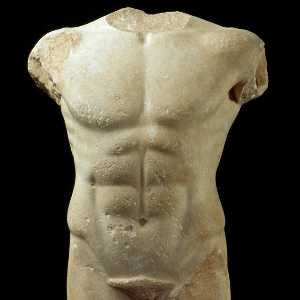
The title of the book is taken from Rilke's poem ARCHAIC TORSO OF APOLLO:
We never knew his head and all the light
that ripened in his fabled eyes. But
his torso still glows like a gas lamp dimmed
in which his gaze, lit long ago,
holds fast and shines. Otherwise the surge
of the breast could not blind you, nor a smile
run through the slight twist of the loins
toward that centre where procreation thrived.
Otherwise this stone would stand deformed and curt
under the shoulders’ transparent plunge
and not glisten just like wild beasts’ fur
and not burst forth from all its contours
like a star: for there is no place
that does not see you. You must change your life.
Sloterdijk unfolds this as a longing very much along the line of Part One of Nietzsche's Zarathustra:
>What appears in the former statue of Apollo, however, cannot simply be equated with the Olympian of the same name, who had to ensure light, contours, foreknowledge and security of form in his days of completeness. Rather, as the poem’s title implies, he stands for something much older, something rising from prehistoric sources. He symbolizes a divine magma in which something of the first ordering force, as old as the world itself, becomes manifest... It is not enough to say that Rilke retranslated ethics in an aestheticizing fashion into a succinct, cyclopian, archaic-brutal form. He discovered a stone that embodies the torso of ‘religion’, ethics and asceticism as such: a construct that exudes a call from above, reduced to the pure command, the unconditional instruction, the illuminated utterance of being that can be understood – and which only speaks in the imperative.
>‘You must change your life!’ – this is the imperative that exceeds the options of hypothetical and categorical. It is the absolute imperative – the quintessential metanoetic command. It provides the keyword for revolution in the second person singular. It defines life as a slope from its higher to its lower forms. I am already living, but something is telling me with unchallengeable authority: you are not living properly. The numinous authority of form enjoys the prerogative of being able to tell me ‘You must’. It is the authority of a different life in this life. This authority touches on a subtle insufficiency within me that is older and freer than sin; it is my innermost not-yet.
Sloterdijk views the religious impulse and the element of religion in everyday life as a framework for practice, which in turn forms the individual:
>The ethical programme of the present came into view for a moment when Marx and the Young Hegelians articulated the theory that man himself produces man. The true meaning of this statement was immediately obscured, however, by another chatter that presented work as the only essential human act. But if man genuinely produces man, it is precisely not through work and its concrete results, not even the ‘work on oneself’ so widely praised in recent times, let alone through the alternatively invoked phenomena of ‘interaction’ or ‘communication’: it is through life in forms of practice. Practice is defined here as any operation that provides or improves the actor’s qualification for the next performance of the same operation, whether it is declared as practice or not.
The title of the book is taken from Rilke's poem ARCHAIC TORSO OF APOLLO:
We never knew his head and all the light
that ripened in his fabled eyes. But
his torso still glows like a gas lamp dimmed
in which his gaze, lit long ago,
holds fast and shines. Otherwise the surge
of the breast could not blind you, nor a smile
run through the slight twist of the loins
toward that centre where procreation thrived.
Otherwise this stone would stand deformed and curt
under the shoulders’ transparent plunge
and not glisten just like wild beasts’ fur
and not burst forth from all its contours
like a star: for there is no place
that does not see you. You must change your life.
Sloterdijk unfolds this as a longing very much along the line of Part One of Nietzsche's Zarathustra:
>What appears in the former statue of Apollo, however, cannot simply be equated with the Olympian of the same name, who had to ensure light, contours, foreknowledge and security of form in his days of completeness. Rather, as the poem’s title implies, he stands for something much older, something rising from prehistoric sources. He symbolizes a divine magma in which something of the first ordering force, as old as the world itself, becomes manifest... It is not enough to say that Rilke retranslated ethics in an aestheticizing fashion into a succinct, cyclopian, archaic-brutal form. He discovered a stone that embodies the torso of ‘religion’, ethics and asceticism as such: a construct that exudes a call from above, reduced to the pure command, the unconditional instruction, the illuminated utterance of being that can be understood – and which only speaks in the imperative.
>‘You must change your life!’ – this is the imperative that exceeds the options of hypothetical and categorical. It is the absolute imperative – the quintessential metanoetic command. It provides the keyword for revolution in the second person singular. It defines life as a slope from its higher to its lower forms. I am already living, but something is telling me with unchallengeable authority: you are not living properly. The numinous authority of form enjoys the prerogative of being able to tell me ‘You must’. It is the authority of a different life in this life. This authority touches on a subtle insufficiency within me that is older and freer than sin; it is my innermost not-yet.
Starting a book club