anon_kutw said in #5398 5mo ago:
I have been reading Chinese and Indian history recently, and naturally I have begun to consider Western civilization in comparison.
The most striking and remarkable observation is how strong the historical continuity is over more than 3,000 years among both Chinese and Indian civilizations in a way that is simply not the case in the West. There is truth to the Lindy effect, and thus to be Chinese or Indian must include a strong feeling of destiny. You can be sure than in another thousand years China will still be standing, certainly as another dynasty, but it will exist as the hegemon of the Orient and people will still read Confucius and the emperor will rule all under Heaven and crime will be low, etc. I have no doubt that the legends of Arjuna and Rama will continue to inspire and live on in the hearts of people across the Indian subcontinent similarly.
The West (if it is real) has less historical continuity, has changed center of gravity, and has changed more over time (perhaps that is precisely why we conquered the world and they didn't). However, at least to me personally, this gives Western Civilization an uncomfortable sense of impermanence.
What the hell is Western Civilization anyway?
The fall of the Roman Empire seems to be a particularly disturbing event that has cast a scar across the whole of Western history and identity. The break in continuity between Antiquity and the Medieval Era is so significant in every way (perhaps other than linguistic?) that I am unsure if we can even consider it to be a single civilization.
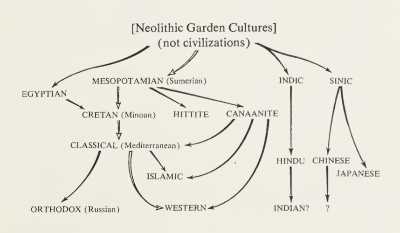
If we are to break up the hegemonic culture of civilization in Europe throughout history, it may be a story of multiple successive civilizations evolving with multiple splinter offshoots. Something like the traditional:
Greco-Roman Antiquity -> Christian Middle Ages -> Modern West
or even
Hellenic -> Roman -> Christendom -> "European" -> "Western"
The lack of a clear definition of "civilization" does not help. Some posit that current Western Civilization is basically Romano-Germanic and Christian, which also doesn't go without contestation.
Worth further pointing out that Western or European civilization is made all the more unusual by the Renaissance, which witnessed a return to Classical Greco-Roman identity in a way that I don't believe has happened in any other civilization over the same stretch of time. The Ming Dynasty had their own Han Renaissance after the Mongol Yuan, but this was only after a period of ~300 years instead of ~1000 and the Yuan cultural break was arguably less intense than Medieval Europe. What is remarkable about this is the fact that these cultural renaissance movements always occur with the implicit claim that the existing form of culture is foreign or unreflective of the true civilizational spirit of the nation. The rejection of Medieval Christian identity during the Renaissance raises the question as to whether Christianity is truly Western or European.
The current domination of the West and Europe by Anglo-Americans is also extremely unusual. "The West" as a term appears to have only emerged out of the desire to include European settler colonies into the fold of European civilization, which was the preferred term in the Early Modern era. Moreover, from a linguistic perspective this civilization spoke Latin or vulgar Latin as the primary language for over 2000 years until the current domination of Germanic English around 150 years ago. Are we even the same civilization?
I am glad that European culture at least did not experience cultural extermination à la Egypt faced with Arabization, and in comparison perhaps we can say "the West" is actually real. But is there any pattern we can extract here?
What language will be speak in 1,000 years? What religion will we be?
Western states appear to last longer than Chinese dynasties. Will the USA be a 2,000 year institution like Rome?
Will the West die and transform (again?) into something else?
Where are we going?
The most striking and remarkable observation is how strong the historical continuity is over more than 3,000 years among both Chinese and Indian civilizations in a way that is simply not the case in the West. There is truth to the Lindy effect, and thus to be Chinese or Indian must include a strong feeling of destiny. You can be sure than in another thousand years China will still be standing, certainly as another dynasty, but it will exist as the hegemon of the Orient and people will still read Confucius and the emperor will rule all under Heaven and crime will be low, etc. I have no doubt that the legends of Arjuna and Rama will continue to inspire and live on in the hearts of people across the Indian subcontinent similarly.
The West (if it is real) has less historical continuity, has changed center of gravity, and has changed more over time (perhaps that is precisely why we conquered the world and they didn't). However, at least to me personally, this gives Western Civilization an uncomfortable sense of impermanence.
What the hell is Western Civilization anyway?
The fall of the Roman Empire seems to be a particularly disturbing event that has cast a scar across the whole of Western history and identity. The break in continuity between Antiquity and the Medieval Era is so significant in every way (perhaps other than linguistic?) that I am unsure if we can even consider it to be a single civilization.
If we are to break up the hegemonic culture of civilization in Europe throughout history, it may be a story of multiple successive civilizations evolving with multiple splinter offshoots. Something like the traditional:
Greco-Roman Antiquity -> Christian Middle Ages -> Modern West
or even
Hellenic -> Roman -> Christendom -> "European" -> "Western"
The lack of a clear definition of "civilization" does not help. Some posit that current Western Civilization is basically Romano-Germanic and Christian, which also doesn't go without contestation.
Worth further pointing out that Western or European civilization is made all the more unusual by the Renaissance, which witnessed a return to Classical Greco-Roman identity in a way that I don't believe has happened in any other civilization over the same stretch of time. The Ming Dynasty had their own Han Renaissance after the Mongol Yuan, but this was only after a period of ~300 years instead of ~1000 and the Yuan cultural break was arguably less intense than Medieval Europe. What is remarkable about this is the fact that these cultural renaissance movements always occur with the implicit claim that the existing form of culture is foreign or unreflective of the true civilizational spirit of the nation. The rejection of Medieval Christian identity during the Renaissance raises the question as to whether Christianity is truly Western or European.
The current domination of the West and Europe by Anglo-Americans is also extremely unusual. "The West" as a term appears to have only emerged out of the desire to include European settler colonies into the fold of European civilization, which was the preferred term in the Early Modern era. Moreover, from a linguistic perspective this civilization spoke Latin or vulgar Latin as the primary language for over 2000 years until the current domination of Germanic English around 150 years ago. Are we even the same civilization?
I am glad that European culture at least did not experience cultural extermination à la Egypt faced with Arabization, and in comparison perhaps we can say "the West" is actually real. But is there any pattern we can extract here?
What language will be speak in 1,000 years? What religion will we be?
Western states appear to last longer than Chinese dynasties. Will the USA be a 2,000 year institution like Rome?
Will the West die and transform (again?) into something else?
Where are we going?
referenced by: >>5423
I have been reading