sofiechan home

What is Western Civilization

anon_kutw said in #5398 3d ago: received

I have been reading Chinese and Indian history recently, and naturally I have begun to consider Western civilization in comparison.

The most striking and remarkable observation is how strong the historical continuity is over more than 3,000 years among both Chinese and Indian civilizations in a way that is simply not the case in the West. There is truth to the Lindy effect, and thus to be Chinese or Indian must include a strong feeling of destiny. You can be sure than in another thousand years China will still be standing, certainly as another dynasty, but it will exist as the hegemon of the Orient and people will still read Confucius and the emperor will rule all under Heaven and crime will be low, etc. I have no doubt that the legends of Arjuna and Rama will continue to inspire and live on in the hearts of people across the Indian subcontinent similarly.

The West (if it is real) has less historical continuity, has changed center of gravity, and has changed more over time (perhaps that is precisely why we conquered the world and they didn't). However, at least to me personally, this gives Western Civilization an uncomfortable sense of impermanence.

What the hell is Western Civilization anyway?

The fall of the Roman Empire seems to be a particularly disturbing event that has cast a scar across the whole of Western history and identity. The break in continuity between Antiquity and the Medieval Era is so significant in every way (perhaps other than linguistic?) that I am unsure if we can even consider it to be a single civilization.

If we are to break up the hegemonic culture of civilization in Europe throughout history, it may be a story of multiple successive civilizations evolving with multiple splinter offshoots. Something like the traditional:

Greco-Roman Antiquity -> Christian Middle Ages -> Modern West

or even

Hellenic -> Roman -> Christendom -> "European" -> "Western"

The lack of a clear definition of "civilization" does not help. Some posit that current Western Civilization is basically Romano-Germanic and Christian, which also doesn't go without contestation.

Worth further pointing out that Western or European civilization is made all the more unusual by the Renaissance, which witnessed a return to Classical Greco-Roman identity in a way that I don't believe has happened in any other civilization over the same stretch of time. The Ming Dynasty had their own Han Renaissance after the Mongol Yuan, but this was only after a period of ~300 years instead of ~1000 and the Yuan cultural break was arguably less intense than Medieval Europe. What is remarkable about this is the fact that these cultural renaissance movements always occur with the implicit claim that the existing form of culture is foreign or unreflective of the true civilizational spirit of the nation. The rejection of Medieval Christian identity during the Renaissance raises the question as to whether Christianity is truly Western or European.

The current domination of the West and Europe by Anglo-Americans is also extremely unusual. "The West" as a term appears to have only emerged out of the desire to include European settler colonies into the fold of European civilization, which was the preferred term in the Early Modern era. Moreover, from a linguistic perspective this civilization spoke Latin or vulgar Latin as the primary language for over 2000 years until the current domination of Germanic English around 150 years ago. Are we even the same civilization?

I am glad that European culture at least did not experience cultural extermination à la Egypt faced with Arabization, and in comparison perhaps we can say "the West" is actually real. But is there any pattern we can extract here?

What language will be speak in 1,000 years? What religion will we be?

Western states appear to last longer than Chinese dynasties. Will the USA be a 2,000 year institution like Rome?

Will the West die and transform (again?) into something else?

Where are we going?

I have been reading received

anon_peko said in #5400 3d ago: received

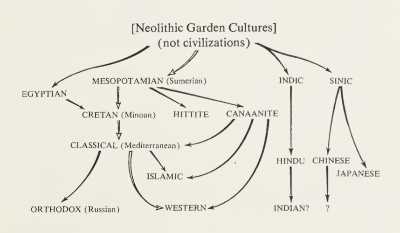
IMO the best theory on this topic is in Carroll Quigley's "The Evolution Of Civilizations". I'm not up to summarizing his definitions of what exactly a "civilization" is, how it's different from a state, and what separates one civilization from another across time, so I'll just summarize the historical picture it gives and recommend the book.

Chinese continuity since 1000 BC isn't much stronger than Western continuity over that time. There have been three Chinese civilizations. (https://www.benlandautaylor.com/p/the-three-chinese-civilizations) The first, ancient Chinese civilization, had its core on the Yellow River. It dissolved c. 400 AD and was overrun by foreign invaders, the "Five Barbarians" from the northern steppe. The second Chinese civilization, medieval Chinese civilization, arose c. 600 AD with its core on the Yangtze River, which had been the frontier of ancient Chinese civilization. They studied the ancient texts and tried to revive the lost ritual practices of ancient Chinese civilization, especially under the Song dynasty. It dissolved c. 1900 AD and was overrun by foreign invaders from Western civilization. The third, modern Chinese civilization, arose in the late 20th/early 21st century, a process still continuing today, perhaps with its core on the southern coast.

Western civilization arose c. 800 with its core in western and central Europe, emerging primarily from the ruins of the prior Greco-Roman (or Classical) civilization, which had its core along the northern Mediterranean until it dissolved and was overrun by foreign invaders from the Germanic tribes. In the Renaissance, Western civilization studied the ancient texts and tried to revive the lost intellectual practices of ancient Greco-Roman civilization. Almost certainly Western civilization will someday dissolve and be overrun by foreign invaders—God willing that will be far in the future—and eventually a new civilization will arise from its ruins.

See the attached diagram from Quigley's book. (Quigley uses "Sinic civilization" for what I call "ancient Chinese civilization", "Chinese civilization" for what I call "medieval Chinese civilization", and has no term for "modern Chinese civilization" because it arose mostly after his death. His diagram omits the very strong Germanic component of Western civilization because Germanic society was not a civilization.)

IMO the best theory received

anon_kutw said in #5401 2d ago: received

I do find Quigley's cycles and especially the "instrument of expansion" framework useful but it is perhaps looking at something that I would not really describe as the primary definition of a "civilization" or at least not as most people would understand that word. I feel that Quigley's cycles could just as easily apply to any large group rather than only "civilizations." Quigley's strength seems to be more on the structure of his cycles rather than his delineations of what defines each civilization.

The use of the word by Samuel P. Huntington in Clash of Civilizations may be the closest to how the term is most widely understood by the public today, which is to say that it refers to a kind of cultural macro-identity (especially amidst an increasingly smaller world).

Great blog post. Even without looking through a Quiglic perspective there is a strong case to be made that Medieval China was substantially different from the Ancient era due to the introduction of Buddhism, and the current China is further differentiated by Communism.

One reason why a Chinese macro-identity appears so strong is because they have spoken the same or a descended language and script over the past 2,000 years, and their geographic center of gravity has not really shifted that much. The blog post mentions a shift from the Yellow River to the Yangtze but that is nothing compared to the distance between Athens and London (let alone the US).

The point about Chinese civilization entering a third phase around 1900 is interesting and somewhat reiterates my initial point because it raises the question as to whether the same has occurred with the West. I would argue that civilizational collapses appear to be getting less bad over time, with the Bronze Age Collapse being lethal, the Fall of Rome being horrible but not as bad, and perhaps somewhere between the 30 Yeah War, French Revolution, and WW2 is our third civilizational collapse. The structure of our current Germanic speaking liberal democratic world order does seem to be extremely different from the Catholic Latin-based European order of 1600. Even the geographic center of gravity has shifted significantly.

I do find Quigley's received

themetasophist said in #5402 1d ago: received

Re: "I am glad that European culture at least did not experience cultural extermination à la Egypt faced with Arabization, and in comparison perhaps we can say "the West" is actually real. But is there any pattern we can extract here?"

Seeing as we are talking about Quigley, he had a lot to say here.

First, he drew a line between Classical civilisation and the West:

"Although Western civilization emerged from the wreckage of Classical antiquity, it differed from it in every important aspect of its culture. Even in its first three stages it had a different military system (based on specialized cavalry rather than on infantry), a different technology (based on animal power rather than on slavery), a different economic organization, a different political organization (formed about rural castles rather than around municipal acropolises), and, above all, an entirely different religious system and basic ideology."

He then classifies the Western ideology as follows:
"While the aristocratic Classical culture had put the golden age in the past, more democratic Western culture put it (and salvation) in the future."

"All these different aspects of the Western outlook cluster about the essence of the outlook that we have tried to express in the statement that "Truth unfolds through a communal process." The outlook to which this statement refers lies at the foundation of Western culture and is reflected equally in its religion, its politics, its science, and its economics.

This outlook assumes, first, that there is a truth or goal or man's activity. Thus it rejects despair, solipsism, skepticism, pessimism, and chaos. It implies hope, order, and the existence of a meaningful objective external reality."

Second, this attitude assumes that no one, now, has the truth in any complete or even adequate way; it must be sought or struggled for. "

Those points aside, declining fertility rates coinciding with the penetration of modernity indicate that society probably needs to radically adapt if we want to survive (maybe selection effects mean the fertility rate will converge to 2.1 again, but really, can we afford to bet on that?). Some kind of transformation is therefore inevitable. Will that still be the West? Quigley thought that the essence of the West was communal truth-seeking. So if we can make truth-seeking adaptive, then the West doesn't need to die at all.

Re: "I am glad that received

anon_kutw said in #5403 23h ago: received

>it had a different military system (based on specialized cavalry rather than on infantry), a different technology (based on animal power rather than on slavery), a different economic organization, a different political organization (formed about rural castles rather than around municipal acropolises), and, above all, an entirely different religious system and basic ideology."

Quigley doesn't really give a good answer to the fact that all of these elements have changed much more significantly during the course of the lifecycle of his Western Civilization than the Classical. People in the late Roman Empire had slavery and infantry and municipal acropolises in basically the same way that they did 1000 years prior, while it would be laughable to even think about castles or cavalry or animal power in the West today. All of these things (plus religion/ideology) pretty much ended decisively by 1850-1920. Seems like we are in a new civilization already.

>"While the aristocratic Classical culture had put the golden age in the past, more democratic Western culture put it (and salvation) in the future."

I suppose the West may have this more than other civilizations, although these two worldviews seem to still exist side by side in America's political system for example. I am not sure we can say everyone (or even the majority) of people in the West is entirely onboard with the idea of eternal change and progress toward some future goal.

Also did not Classical Greece and the Roman Republic have more direct participation of their citizens in governance than most of Medieval Europe? Perhaps Quigley could make his case due to to lack among Western societies of the same kind of absolutism that developed in the later Classical period.

>This outlook assumes, first, that there is a truth or goal or man's activity. Thus it rejects despair, solipsism, skepticism, pessimism, and chaos. It implies hope, order, and the existence of a meaningful objective external reality." Second, this attitude assumes that no one, now, has the truth in any complete or even adequate way; it must be sought or struggled for. "

Is Catholicism not Western then? Does it not claim to hold divine truth? Despite the Reformation, most places in the West are still Catholic today.

>Quigley thought that the essence of the West was communal truth-seeking.

Is this to say that the West just embodies this more so than other civilizations or that it is the definition of Western? Communal truth seeking has played a big role in a lot of cultures, including ancient Athens which Quigley would label as non-Western. India, the Islamic World, and China were also literate and definitely engaged in debates through science and schools of philosophy.

The spread of democratic institutions and universities also raises the question as to whether the entire world is basically just Western Civilization now with the possible exception of China if we want to define Communist civilization as some unique offshoot of Western or Orthodox civilization stemming from the 19th-20th century or if they are still quintessentially Chinese.

If we define Western civilization as being this forward looking democratic form while Classical was nostalgic and aristocratic, that also seems to be a mark against China constituting different civilizations from the Zhou to the Qing, no? Is there really a perspective shift between Ancient and Medieval Chinese civilizations in terms of fundamental values? Buddhism enters the scene but it is never taken seriously in the realm of governance, which remains dominated by Confucianism. This seems substantially different from the overwhelming dominance of Christianity on all Western institutions.

Quigley doesn't real received

anon_syze said in #5405 39m ago: received

Hi! I’m Jessie Lydia Henshaw, a natural systems scientist. — I’ve studied the question from a combination of natural system design and culture-change pattern recognition views. I found a recurring pattern originating with the first western economic civilization starting with the merging of two middle eastern cultures about 9,000 years ago, the Neolithic farming and teaching culture that would become the Hasidic, that I call the Sids, along the Jordan river. The second is the artistic engineering culture in what would now be northern Syria, the Gobekli Tepe people I call the Tepe for short,.who created very beautiful stone slab ritual centers supported by efficient wild range harvesting of both plants and animals. but suffered unrepairable earthquake damage twice and migrated south, and in the process joined up with the Sids. They combined to form what became a collectively managed diverse economic system mainly in the Fertile Crescent that later spread south to Mesopotamia to the East and Egypt in the west,

So far that describes what one might call the typical honeymoon period of Western civilizations, this one lasting about 3000 years till a culture of scribes emerged inventing cuniform palm tablets to record transactions and credits, that apparently invented exponential growth. That produced dozens of wealthy city states in Mesopotamia which repeatedly began to blow up in their faces, Tat was recorded in the Bible as the “Tower of Babel.” If someone ever learns how to read that business language there might be much more to say, other than that was the first form of cogent writing,

Apparently the Bible story merged the many early failures of what appears to be what we now call capitalism, into one myth, as being of a great stone tower, but really referred to a great tower of babel, a tower of confusion. There are traces of that interpretation elsewhere in addition to it being what we ourselves see as a great tower of confusion as the emerging state of modern civilization, and clearly also marking the other three descendent collapses following their long honeymoons with terrifying collapses — of the Bronze Age, Greece#2, and Rome.

What seems to be the culprit is the management of successful economies to maximize their growth, which in turn, blinds the managers to the grave risks being taken,,having became dependent on abstract counting methods as their reality. That reality would naturally be unaware of the ever growing interference in the organic cultures of nature that would dependably sneak up on them and misbehave in unpredictable ways when pushed to expand exponentially.

There’s an illustration of the end state of the Bronze Age collapse at the link below that shows the pattern of a few of the more prosperous, mostly walled citystates of the Eastern Mediterranean being destroyed at a time from about 1220 BCE to 1150 from the inside, but only attributed to “The Sea People” a real kind of mixed gender pirate culture that also left little trace. There’s also a good archeological book on this called “1177 BCE”. I have more on it on my research notes and references site: synapse9.com/signals “Signals” refers to the way animated natural systems communicate, that many others can read, i.e. the language of nature you might say. People, of course all have their own sensitivities to change as a way of readin it, though once much more widely relied on, and now gets all mixed up with abstractions.

Hi! I’m Jessie Lydia received

You must login to post.