This is an important article that deserves debate. It details and substantiates the systemic expulsion of young white men from prestigious American institutions, especially in media and academia, from 2014-2024.
1. Who to blame. The story points at older white men, who held on to leadership positions while participating in woke hiring purges. This makes them cowards at minimum; but begs the question of why they felt pressure to do that in the first place. Obama? The Jews(TM)? Why 2014, specifically, vs earlier or later? Receipts needed.
2. Where Trump went wrong. Right in the middle of this period is a whole ostensibly right-wing administration. Blatantly illegal race-based discrimination only grew during this time, culminating in Peak Woke in 2020/21. So on the face of it, Trump 1 badly failed young white men. Why?
3. The Civil Rights Act. I’ve had debates on here and irl about the merits of the CRA. There is a whole Yarvin edgelord take about Civil Rights being some communist victory against America. I am unconvinced. Taft-Hartley was very bad, 60s urban governance was trash, and some CRA case law (notably Duke Power / disparate impact) has been very damaging. But the CRA itself is very clear and prohibits discrimination on the basis of race. This is useful. Singapore has similar de jure colorblindness but they actually mean it over there. The way I see it, the CRA is ours now and must be enforced aggressively.
Which really brings us back to #2- given widespread and flagrant violation of the law against one of his core constituencies, what the hell was the Trump DOJ doing then? And what are they [failing to] do right now?
I think a discussion like this has to begin with at least a sketch of how these industries—entertainment, journalism, and so on—were decimated over the past quarter-century.
In the year 2000, there were still about half a million people working for newspapers and magazines, but within twenty years, that number collapsed by about eighty percent. There were not many jobs in journalism that were safe. Entry-level positions were scarce.
At the same time, internet media took over. Web publications did hire some senior white male refugees from traditional media. They did sometimes need people capable of writing and editing a ten-thousand-word cover story, or assembling sources for an investigative piece, or researching and fact-checking and interviewing. But that wasn't the bread-and-butter of most of these outlets. The essential workers were the army of freelancers and low-paid writers churning through articles of a few hundred words on a hot topic, listicles, and provocative editorials. You could run a web publication without much of the infrastructure of a newsroom, without paying a J-school graduate enough to cover their student loans, without very many warm bodies at all. Serious jobs became scarce. There was fierce competition for them.
The people in charge of turning a profit (these were white males, too, by and large) saw the white male holdouts as mostly dead weight—overpaid, unnecessary to the new paradigm, incapable of penning faggy gossip columns or embittered memoir—and their truly essential employees—homosexuals and women, mostly, who had found a refuge in internet media—took advantage of this, as well as a culture-wide racial reckoning, to fight their way into leadership positions.
In my own limited experience, some of those white male holdouts, seeing how vulnerable their position was, and generally being craven, guilt-ridden progressives, were unwilling to challenge the demand to replace themselves with scheming Asian women and sinister Hispanic homosexuals, who were themselves fighting for their lives in a competitive, shrinking field. Gay race communism served the bottom line: cut salaries for five senior white men, offer a resentful Pakistani broad pennies on the dollar for a cool title, and promote ESL students and semi-literate black women earning a nickel a word).
But very soon, it was clear that few people were actually essential. Advertising revenue dropped. The slaughter intensified during the pandemic. At all of these places, whether traditional media with a web presence, or native internet media, jobs were slashed again.
I would argue that a lost generation, at least in journalism, was created by the rapid choking-out of the industry (by financialization and speculation, by deregulation and austerity logic, and so on), more than it was by the spineless generation X homos, daughters of Vietnamese dentists that won their jobs by haranguing those men about racial injustice, and Machiavellian homosexuals.
It's hard to see them as the winners in all of this. The journalism industry has not become a vast make-work program for angry second-generation immigrants, but is a wretched shell. The ongoing economic and social transformation in service of short-term gains will wash them out, too.
If you want to save a generation of white men, there are more challenging hurdles to overcome than ending discriminatory hiring, or booting out the blacks to install good men in precarious posts in a dead industry. When you come up with a scheme for resurrecting the entire industry, or raising something credible in its stead, the wrongs can be righted.
Anyways, in short: you claim technology decreases the need for labor, and there were not fake jobs created in this industry. This holds true.
You then try to draw attention away from the negros and the jews, saying it's a systemic problem that magically happened and that figuring out the people who caused it would be futile.
Obviously since there is systemic racism, like against George Floyds, we should thus do the same thing the left did and sit on our butts and do nothing.
>>4851 I'm okay with the suggestion I must be a fruit or whatever, but I do want to make my conclusion clear.
I would say, anyone that cares about this sort of thing and is willing to go beyond resentment should take part in building something beyond mouldering legacy outlets and the remaining new media ventures. They should find reliable patrons, or become reliable patrons. They should study the forces that strangled journalism (or publishing, or film, or whatever) and set up their ventures to neutralize them. And when the starving refugees show up at the gate, massacre them.
Contrary to what it may seem I'm not actually an antisemite. I'm describing what your motivations appear to be despite the layers of obfuscation, but if the natural proclivity is toward disorder and consumption this is at odds with those who prefer order in their life. I feel quite bad about how Betteljuden, gypsies, or even economic migrants today are treated---yet sympathies and necessity are often at odds with each other. Knowing what it means to starve, one would think there is plenty within the city walls to share. Knowing how long such surplus took, one is naturally parsimonious.
They took down the Robert E. Lee statue in the Capitol lately as did Trump put these plaques below his predecessors, and despite my wishes I fear we will not have the gentlemen's reconciliation because of the constant imposition of Carthaginian peace treaties by both.
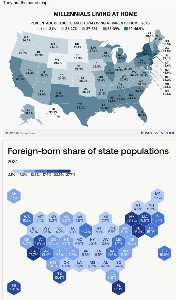
Jim Bowery https://www.blogger.com/profile/12686155123469135528 spotted this fascinating combination of charts that show how inability of young people to start a family correlates with the importing of aliens.
I see no evidence that greater immigration causes lower native fertility. Rather, coastal states are more urbanized > more expensive, more liberal, more immigrants. The high percentage of millennials still living at home is directly related to expensive housing.
There is a slight causation here. On the margin, more immigrants do increase housing prices. But cities like NY or SF would have far higher rents and consequently more 30yo failsons living with their mom than Des Moines regardless of immigration rate.
The elephant in the room is that the Anglosphere has completely forgotten how to build. Our coastal metros have huge undersupply of housing, subways, and frankly basic infrastructure; it is completely absurd that a city like SF has overhead power lines and no fiber internet. Asian cities with literally a tenth the municipal budget per capital are mogging us on all of the above.
But even this is primarily a national competitiveness issue. It may or may not help birthrates. Places like Italy and Japan have cheap housing , good public spaces, nice cities… and the birthrates are in the gutter anyway.
That’s not to say we shouldn’t fix the problem. It’s still critical. But fertility is fundamentally a spiritual problem and must be fixed at a cultural level by celebrating the big health family as an aspirational goal. Exactly the opposite of what our cultural institutions have done for the past 30 years.
TLDR; remigration good, but won’t fix the expensive city problem. Building aggressively good, makes cities cheaper and better, but still won’t fix the fertility problem.
I wanted to expand the scope of the 'lost generation' in this thread beyond taking jobs away from qualified people based on their race or gender (where tracking such replacement would probably be a worthwhile investment for anyone interested in acquiring this voter base).
I also wanted to show how this sociopolitical milieu is suffocating whole generations. Correlation is not causation: but the values and behaviors of left-wing cities are probably the causal origin for many forms of dysfunction.
I don't think any of these problems (building, fertility, affordability) can be solved one at a time, as you allude yourself. But I also agree that the real solution is the creation of a new milieu, of a new movement. We need something that will attract and organize people.
I think we need to create a new Radical Left, and brand the old radical left as the new conservative movement which it is: > Two-thirds of U.S. Senators are over the age of 60, with Democrats averaging 63.7 years old.
>>4872 > I think we need to create a new Radical Left
The socialism will continue until morale improves?
You have to at least try to articulate how your version would differ and why it would be any better.
But maybe you're onto the edge of something important.
Above and beyond all other problems discussed in this thread, there is a big horn-blowing freight train coming our way. Many on this board seem to be in a state of utter cope about it, but it is coming regardless: the age of hyperautomation.
What happens as the freight train hits? We get a sharp acceleration of the gift-curse of industry: material abundance on the one hand, widespread human redundancy on the other. During previous waves of industrialization, many of those affected could be redirected to increasingly abstract forms of work--factory button-pusher, office paper-pusher, culminating in today's email jobs. But with hyperautomation, all of these become increasingly untenable.
The combination of mass abundance and mass redundancy will yield political turmoil. The moment calls for something new; is it a "new Radical Left"? I press X to doubt. But it certainly involves harnessing populism. You note that we live under gerontocracy; the gears of government get rustier and rustier, even as technology accelerates. Clearly something will have to give.