admin said in #5221 6mo ago:
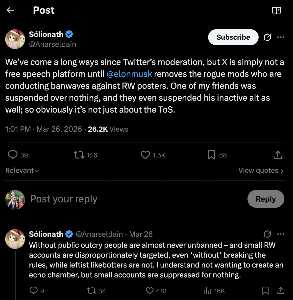
The most interesting and ideologically cutting edge Twitter posters and demographics are still systematically suppressed and often lose their accounts. Elon pretends ignorance but may have made a deal with the advertiser cabal to continue the old network disruption policy and promote populist fyp sludge in exchange for deescalation. Mass report brigades also play a role on key topics. Clearly we need better platforms.
Here's my solution: a fair algorithm where you keep the clout you earn and no one can take it away from you or censor you. You might get hit hard and lose a bunch in one engagement, but never more than you know you're risking. You can't get shadowbanned because the server doesn't even know who you are. Dox risk is minimized by multiple identities and on-tap anonymity, and there being no identifying records on the server that even could be leaked. With those measures, friendly moderation would be a cherry on top, not a last resort.
I'm going to call it zero-knowledge anonymous reputation: the principle is that all reputation information is held client side as anonymous spendable notes, nym keys, and zero knowledge merit credentials. When you post, your client stakes some of your reputation notes, maybe invokes some of your credentials with zero knowledge proofs, and spins up a new nym. As far as the server or anyone else knows, you could be anybody. De-anonymization and user tracking becomes extremely difficult: they would have to hack your client or get you with stylometry.
Moderation is still possible: the server controls the reputation algorithm that defines who gets the notes and credentials, and what kind of behavior burns them or earns them. But client-owned anonymous reputation makes this fair and transparent: you're not getting banned, just losing a stake. There is no two-tier policing because the mods or server can't tell what tier you're in except by exactly what you did. But the mods can still shape what kind of discussion they are trying to drive on the platform. But their options for cloak and dagger network suppression become limited.
I'm sure in the hands of the trust and safety operators at Twitter, this could still be made to suck. A truly hostile platform could just move away from it. Mostly it's a credible signal from the platform of commitment to real anonymity, real fairness. It's a supplement to friendly moderation. It's also a credible signal to would-be hackers, discovery lawyers, and legal censors: we don't have that kind of information, nor the power to do what you are asking. Go play stasi with someone else. It also takes us closer to a fully censorship-resistant protocol so that if push came to shove with a regime hostile to free speech, it would be easier to go there than back in the box.
I've mostly finished the design for a next-gen sofiechan reputation and identity protocol that would have these properties. I didn't used to think it was worth it: most of what we're banking on here is *social* anonymity and friendly moderation. But it has recently seemed more possible and is now on the long-term roadmap.
Of course the short term roadmap (if we ever get the time again) is still dominated by usability and operational improvements. But I'm curious if full technical anonymity would as exciting for you as it is for me.
Here's my solution: a fair algorithm where you keep the clout you earn and no one can take it away from you or censor you. You might get hit hard and lose a bunch in one engagement, but never more than you know you're risking. You can't get shadowbanned because the server doesn't even know who you are. Dox risk is minimized by multiple identities and on-tap anonymity, and there being no identifying records on the server that even could be leaked. With those measures, friendly moderation would be a cherry on top, not a last resort.
I'm going to call it zero-knowledge anonymous reputation: the principle is that all reputation information is held client side as anonymous spendable notes, nym keys, and zero knowledge merit credentials. When you post, your client stakes some of your reputation notes, maybe invokes some of your credentials with zero knowledge proofs, and spins up a new nym. As far as the server or anyone else knows, you could be anybody. De-anonymization and user tracking becomes extremely difficult: they would have to hack your client or get you with stylometry.
Moderation is still possible: the server controls the reputation algorithm that defines who gets the notes and credentials, and what kind of behavior burns them or earns them. But client-owned anonymous reputation makes this fair and transparent: you're not getting banned, just losing a stake. There is no two-tier policing because the mods or server can't tell what tier you're in except by exactly what you did. But the mods can still shape what kind of discussion they are trying to drive on the platform. But their options for cloak and dagger network suppression become limited.
I'm sure in the hands of the trust and safety operators at Twitter, this could still be made to suck. A truly hostile platform could just move away from it. Mostly it's a credible signal from the platform of commitment to real anonymity, real fairness. It's a supplement to friendly moderation. It's also a credible signal to would-be hackers, discovery lawyers, and legal censors: we don't have that kind of information, nor the power to do what you are asking. Go play stasi with someone else. It also takes us closer to a fully censorship-resistant protocol so that if push came to shove with a regime hostile to free speech, it would be easier to go there than back in the box.
I've mostly finished the design for a next-gen sofiechan reputation and identity protocol that would have these properties. I didn't used to think it was worth it: most of what we're banking on here is *social* anonymity and friendly moderation. But it has recently seemed more possible and is now on the long-term roadmap.
Of course the short term roadmap (if we ever get the time again) is still dominated by usability and operational improvements. But I'm curious if full technical anonymity would as exciting for you as it is for me.
The most interesting