sofiechan home

Aristocracy and Nature

anon_naba said in #5330 1d ago: received

Can an argument be made that the ecological destruction that humans have done lies mostly with the turning of power from the aristocracy to the bourgeoise? While there are cases about how the aristocracy led to the extinction of some animals (like some for their plume feathers), the general ethos of the aristocracy (meaning the best rulers in Latin) is that they are the protectors of society, and in many cases upholders of a world that heaven, God, or another spiritual entity has created. With the bourgeoise taking power in 19th century Europe this might have changed with the capitalists holding no allegiance to protect anything other than their interests, leading them to freely destroy the environment (leading to events such as the great stink in England).

Note I’m not saying that not saying that the medieval nobles are these nature loving hippies who danced in circles around trees wearing flower crowns, but that at least the claim of their purpose in society prevented them from engaging in similarly atrocious behaviors as the bourgeoise in the Industrial Revolution.

referenced by: >>5336

Can an argument be m received
anon_dahu said in #5331 1d ago: received

Absolutely not. The process of industrial intensification, acceleration, population growth is fundamentally technological not political.

The solutions are also largely technological. The transition from coal and oil to solar, nuclear and battery, for example, is leading to both ever greater automation and to lower pollution and carbon intensity.

The idea that our lost European aristocracies were fountains of wisdom and good governance is absurd. They were sclerotic and thoroughly outcompeted by Anglo capitalists.

Absolutely not. The received

anon_naba said in #5332 1d ago: received

>fundamentally technological not political.

The way society bred and supported capitalists led to their domination by technological advancement however

>The idea that our lost European aristocracies were fountains of wisdom and good governance is absurd

I guess, but then again their raison d’etre was to be of the best stock as the guardians to society. This mindset, while definitely not embraced wholly, regardless made them operate in a nobler manner than compared to the vaishyas or merchants. There’s a reason why they were despised as a class in China, Japan, and other East Asian nations, and it’s for how they hailed no allegiances beyond capital(along side other reasons like how they didn’t produce anything innately). The social and environmental deterioration in this age of Kali Yuga may be the result of the Vaishyas usurping power over the nobility and this valueless materialist age is just a reflection of the worldview of them.

The way society bred received

anon_hiwe said in #5336 4h ago: received

>>5330
Let's take the example of Britain briefly. The aristocracy preserved many things, and expanded the Anglo race over the world, but it wasn't perfect. I believe Scotland was deforested in the middle ages for firewood, for example. But deforestation aside, it wasn't really until the rise of the industrial bourgeois in the 18th and 19th century that eco-conservation was even a coherent question. Then we got industrial-scale whaling, mining, pollution, etc. Bad, but I don't think linked to the attitudes or position of any one class except in that the industrial program itself was associated with bourgeois modernity. Many aristocrats partook, and many bourgeois families were very responsible.

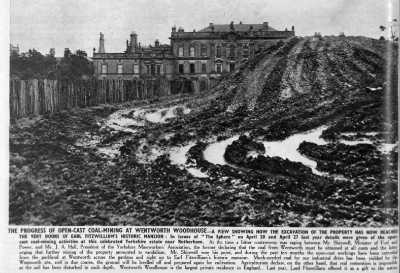
One big example that illustrates it for me is what happened in England after the war. There is a famous example of a coal mining concern that was run by an aristocrat. The Fitzwilliam estate, Wentworth Woodhouse. Paid his workers well, was loved by the community, sustainably kept the mine going for the long haul with minimal ecological damage to the estate. Then after the war in which Churchill sold the empire out to the jewish left in exchange for stroking his ego and feeding his alcohol habit, the socialists ordered some kind of ridiculous nationalization and strip mining operation. This completely destroyed the estate, the mine, the community, etc. Very short term rapacious, probably vindictive against the aristocrat. You see similar hatred and resentment now driving the pollution of the ganges, destruction of municipal public parks by lawlessness, extinction of charismatic species like rhinos in Africa, destruction of environmental organizations by leftist race politics, mass immigration driven environmental problems, etc.

Not all clearcutting and rape-mining is political like that, of course. The other big half is the more "apolitical" rapaciousness from the finance class especially. Their rise is political and there's a certain goblin-like glee in the destructiveness of some of those projects, so maybe that's a point for your bourgeois guilt model. But this is also just the shape of industrial modernity, and they are only one type of bourgeois. The environmentalists were also bourgeois.

I think the most predictive variable isn't aristocracy our bourgeois. People are always more particular than that, defined by ideology and race as much as economic or class position. Much of the damage was done by people who used the term "bourgeois" as a derogatory slur. It was small-minded resentment-driven leftists and vindictive bureaucratic callousness. Is that bourgeois? I am suspicious of either marxist or evolian class essentialism. Look at the actual groups of people and their particular interests and worldview.

Let's take the examp received

You must login to post.